‘I like writing music; it’s been something embedded in my relationship with music since my early years’
Interview with Xavi Torres

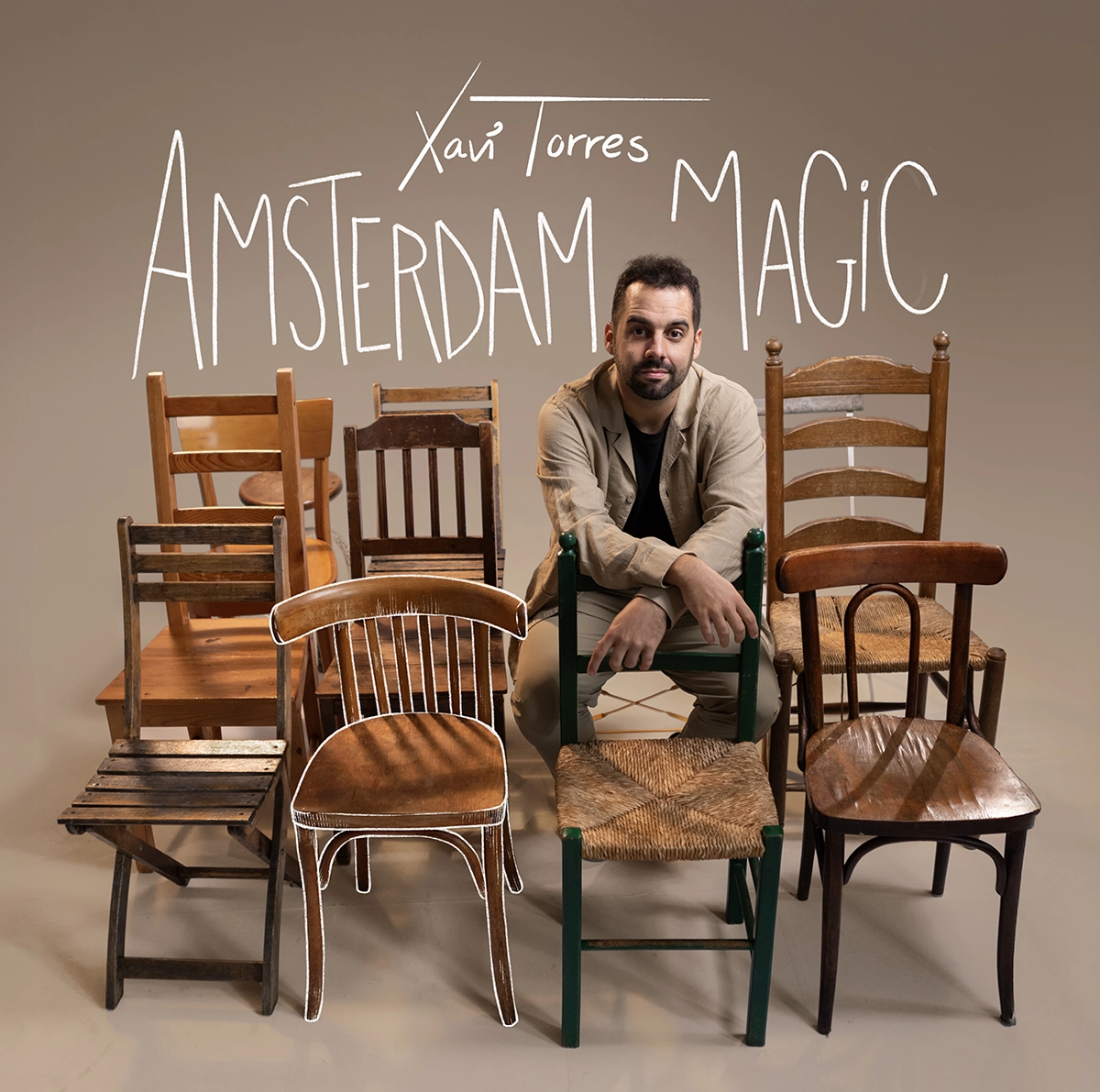
Amsterdam Magic is the title of pianist-composer Xavi Torres’s album of duets, out now on Just Listen Records. Consisting of eleven collaborations with musicians he admires, Amsterdam Magic was recorded in Banana Bread Studio, located at the historic Kerkenstein estate near the Waal River. The album is proof of Xavi’s connection with the jazz scene in the Netherlands and an ode to all the musicians he has played with, studied with, and considers his peers. We asked him a few questions in between his many trips and tours…
Where is home?
‘Nowadays I feel at home both in Amsterdam and in Barcelona/Tarragona. To be honest, I think I don’t need much to feel at home. But people play an important role—family and friends—and having a space where to relax and play the piano.’
What is the best and what is the worst of the Netherlands?
‘I enjoy its openness and appreciation for culture and art. I really find Amsterdam gorgeous and enjoy its balance between being a human-sized city and having such an international society and so much culture around. It’s fantastic to be able to go by train practically anywhere in the country. Ah! And I actually enjoy the times people eat in the Netherlands! And the worst… Maybe not the best culinary tradition? And the grey skies…’
About Xavi Torres
Born in 1991, hailing from Tarragona in Spain, and well-settled in The Netherlands, Xavi has become a staple of the Dutch jazz scene, performing solo, with his trio, or as a sideman (the flamenco jazz groups of Bernard van Rossum, Sam Newbould Quintet, Barencia). He has written music for FUSE, Dudok String Quartet and the Intercontinental Ensemble, among others. He has extensively studied jazz and classical piano, reworked Beethoven for his Kind of Beethoven project in 2022, and received rave reviews for his 2023 trio album Quarantena Songs. In the spring of 2026 the new Xavi Torres Trio album will be released, featuring guest performances by Miguel Zenón and Rita Payés, two high-profile acts Xavi has worked with in the past years.
About Amsterdam Magic
On Amsterdam Magic we hear Xavi play duets with Ben van Gelder, Reinier Baas, Tineke Postma, Fuensanta, Jamie Peet, Julia Philippens, Jasper Blom, Jesse van Ruller, Harmen Fraanje, Joris Roelofs en Clemens van der Feen.
Website: xavitorresmusic.com
Instagram: xavitorresmusic
Apple Music: Amsterdam Magic
And of Spain?
‘It’s a big country with quite some differences, difficult to summarise. A rich and varied country is already something very positive for me. But I’d also say the food is great everywhere (my favourite worldwide), the easy-going attitude of most people, and the outdoor culture. The worst goes to the ruling class, the corruption, bad management, and the inability to properly clean up our fascist past.’
Different paths
How do you make a living?
‘My main income comes from performing concerts, both as a leader and as a sideman of different projects. I enjoy playing a lot, and traveling is not a big burden so far. A couple of years ago, I’ve started teaching at the Conservatorium van Amsterdam and less steadily in Barcelona as a main piano teacher. It’s something new and challenging for me, but I’m enjoying it.’
Can you explain your approach to composing?
‘I like writing music; it’s been something embedded in my relationship with music since my early years. But at the same time, it’s a lot of work, and you need consistency to get things done, deal with deadline stress, etc. But I visualise myself writing music for as long as I’ll play music. I write mostly at the piano, mostly searching for melodies but trying to use different parameters and starting points to find different paths. This year, I pushed myself to write two whole new projects. The Amsterdam Magic duos, and a new trio album with Miguel Zenón and Rita Payés as guests, so I’ll take some time now to let the inspiration back in.’
Classical music versus jazz music: how do you look back on your Beethoven project?
‘I was just lucky to be able to perform with that project again in Gijón, North of Spain. I like it. It was a sort of research project for me. I put a lot of energy into learning Beethoven’s Piano Sonatas—I would sight-read all of them at home, trying to find inspiration and which ones would be best to work around, improvising. I would definitely change some things by now, but I still enjoy it and feel that it has a nice balance between being adventurous, original and respecting the score and making it meaningful.’
Just meeting in the studio
Given all your musical connections, how did you choose the duo collaborations?
‘The choice was purely musical; these musicians are some of my favourites not only in the Netherlands but worldwide. Also, I like the idea of them being these musicians I looked up to and who I wanted to be able to play with in my first years here. The difficult part was choosing to leave out some names that I would have loved to add. But either they couldn’t, or adding them would have made the project a bit unbalanced… Luxury problem… Such a rich scene we have here!’
It sounds easy: a musical idea via email, an appointment for a one-take recording session, done. How about the deeper commitment to the music? Or is a snapshot all there is, always?
‘This is part of the uniqueness of this project. The logistics weren’t easy with eleven different musicians, so I embraced this idea of just meeting in the studio. The deeper commitment comes, on one hand, from the compositions I wrote specifically for each of the musicians. On the other hand, the excellent playing of the performers. They prepared the music so that from the first take, it sounded real and meaningful. I am grateful to them. Of course, there’s meaning in having something steady and developing it together, but I reckon the magic of this project lies in this spontaneity and risk.’
You wrote for each player specifically? If yes, how does that work? What do you have in mind when thinking of Tineke Postma’s playing? Or Julia Philippens’ or Jamie Peet’s?
‘I did write specifically for each of them. I try to empathise with what I like most about them while also seeking a balance between the songs. So for instance, with Tineke, it was the first song I wrote, and it came out quite smoothly, featuring a long but singable melody with a sort of bitonal hook at the end. I left the solos to be very open since I love the free approach that Tineke has. Julia and I played as a duo for a while. She’s a great classical player as well, so I went a bit that way, writing a long melody where we could fluctuate a bit with time and combining some gracious/humoristic sounds with others more serious.’
‘With Jamie I wanted to have something complex rhythmically and with different subdivisions that also would work as a contrast with the other pieces. With Clemens, I wanted to feature his bow playing… With Reinier the starting rhythm comes from one of his ideas (subdividing a 12/8 into odd groups. In this case, 2, 3, 2, 3, 2. Ben’s piece features fast arpeggios that almost only he can play, plus a sort of Brazilian rhythm – because when I was writing it he was there! So, there’s all types of different ideas, but always with the intention to spotlight their artistry and magic.’

A homage
How do you see this music compared to your trio’s output? Will it all be one thing, eventually, or do you keep projects separate?
‘So far, the trio feels like a keystone of my musical output. I’m doing different things, but the trio stays there. I love it, and as I said, there will be a new trio album next year—with guests. This duo project is an ode to my life in Amsterdam and all these musicians I admire. I decided on the album title while biking around the city. It’s a homage to this place that has given me so much. So, it feels more like a one-time thing—a fun one!’
‘I decided on the album title while biking around the city.
It’s a homage to this place that has given me so much’
Lastly, how do you deal with bad pianos while on tour? In other words, how picky are you, and can you be?
‘Good question! I consider myself not to be too picky. On one hand, it is clear that it affects the way I play and therefore the quality of the performance. So I try to aim for the best piano possible—especially as a leader, where I’m playing melodies, et cetera. I put a lot of effort in the craft of piano playing (even studying a classical piano bachelor), so it’s a pity when the piano can’t get the nuances. On the other hand, I consider every chance to play a luxury, an honour, and a responsibility to bring the best out of me. So it’s a balance between these two things. It’s interesting, while on tour, how different you sound with different pianos…’
‘I also connect with the social aspect of it. Often low-budget places don’t have the piano you’d wish for, but I appreciate the effort to organise live music, so I feel part of it. I try to aim for the best piano possible, but once I am on stage, I definitely do my best with the one in front of me.’
This article was published on 17 December 2025.
Text by Mark van Schaick
Photos by Anisa Xhomaqi